

Anthropic has donated the Agent Skills standard to the Agentic AI Foundation (AAIF), which sits under the Linux Foundation. The specification itself is not changing; what changes is who governs it. If you already write skills, nothing breaks today. If you build agent products, the format is now less tied to one vendor. This is an analysis of published announcements and coverage, not a hands-on test.
What was announced
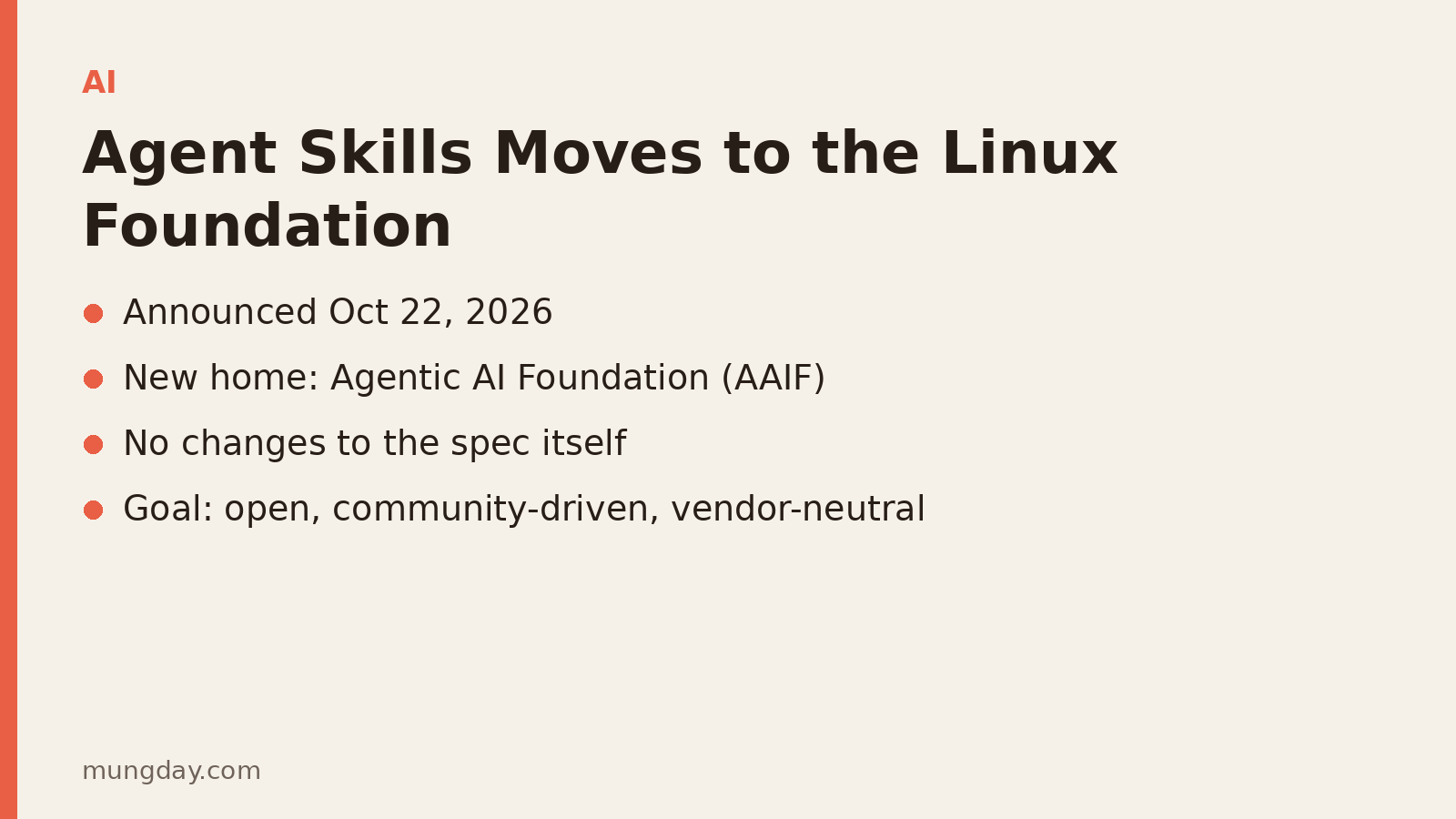
On October 22, 2026, Anthropic said it is donating Agent Skills to the AAIF. Per Simon Willison’s write-up, Anthropic’s wording is: “We’re committed to keeping Agent Skills open, community-driven, and vendor-neutral.” The same post notes the AAIF is the recent home of the MCP specification.
According to Let’s Data Science, Agent Skills is one of four new AAIF projects, which brings the foundation to 10 hosted projects. The same report says the announcement describes no changes to the specification itself.
What changes and what does not

- Changes: governance. A neutral foundation, not a single company, now stewards the standard.
- Stays the same: the format. Skills are still packaged instructions, scripts and resources that agents load on demand.
- Precedent: Anthropic took the same route with MCP less than a year ago, according to the same report.
Who should care
| Reader | Practical effect |
|---|---|
| People who write skills | No migration needed based on what has been published. |
| Teams building agent products | A vendor-neutral home makes cross-product support an easier call. |
| Claude users | No visible change expected. |
For background on how Anthropic’s products are evolving, see our posts on Claude and Google Cloud automation and Anthropic’s S-1 filing.
Limits and open questions
The announcement coverage does not spell out the maintainer structure, licensing details or roadmap under the AAIF. Governance by a foundation also does not guarantee that every agent product will adopt the format. Donations like this reduce lock-in risk, but adoption is what makes a standard useful, and that is yet to be demonstrated by rivals.
My take
This is a sensible, low-risk move: it costs users nothing and removes an objection from competitors. The thing to watch is whether other vendors commit to shipping skills support, and who sits on the technical steering group.