

Google announced Gemini 4 Carbon on November 10, 2026, with an introductory API price of $2 per million input tokens and $10 per million output tokens in US dollars. Google’s footnote says that price ends November 30, 2026, after which it rises to $4 and $20. If you build coding or agent tools on the paid Gemini API, it is worth a short test now. If you only use consumer apps, access depends on your plan. This is an analysis of Google’s announcement, not a hands-on test.

What Google announced
In its launch post, Google says it is making Carbon available to developers, enterprises, scientists and consumers. Developers get it on the paid tier of the Gemini API in Google AI Studio and Android Studio. Google AI Ultra subscribers get a rollout in Google Antigravity, the Gemini app and AI Mode in Search.
Two groups get special programs. Scientists can apply for free access for 6 months, and cyber defenders can get Carbon for cyber through the Fairwind Program. Both are rolling and subject to eligibility and capacity.
Pricing: the number that matters is the second one
The launch price is the same as Gemini 4 Argon’s introductory price. The footnote in Google’s post puts the step-up at November 30, 2026, doubling the rate. Budget against $4/$20, not $2/$10.
| Period | Input (per 1M tokens) | Output (per 1M tokens) |
|---|---|---|
| Introductory, through Nov 30, 2026 | $2 | $10 |
| After the intro period | $4 | $20 |
All figures are US dollars from Google’s post. Google also says Carbon uses more tokens than Argon, so the cost per task will not scale only with the list price. Google claims its own cost-per-task advantage on several third-party benchmarks, but those are vendor-reported numbers.
What Google says about safety and agents
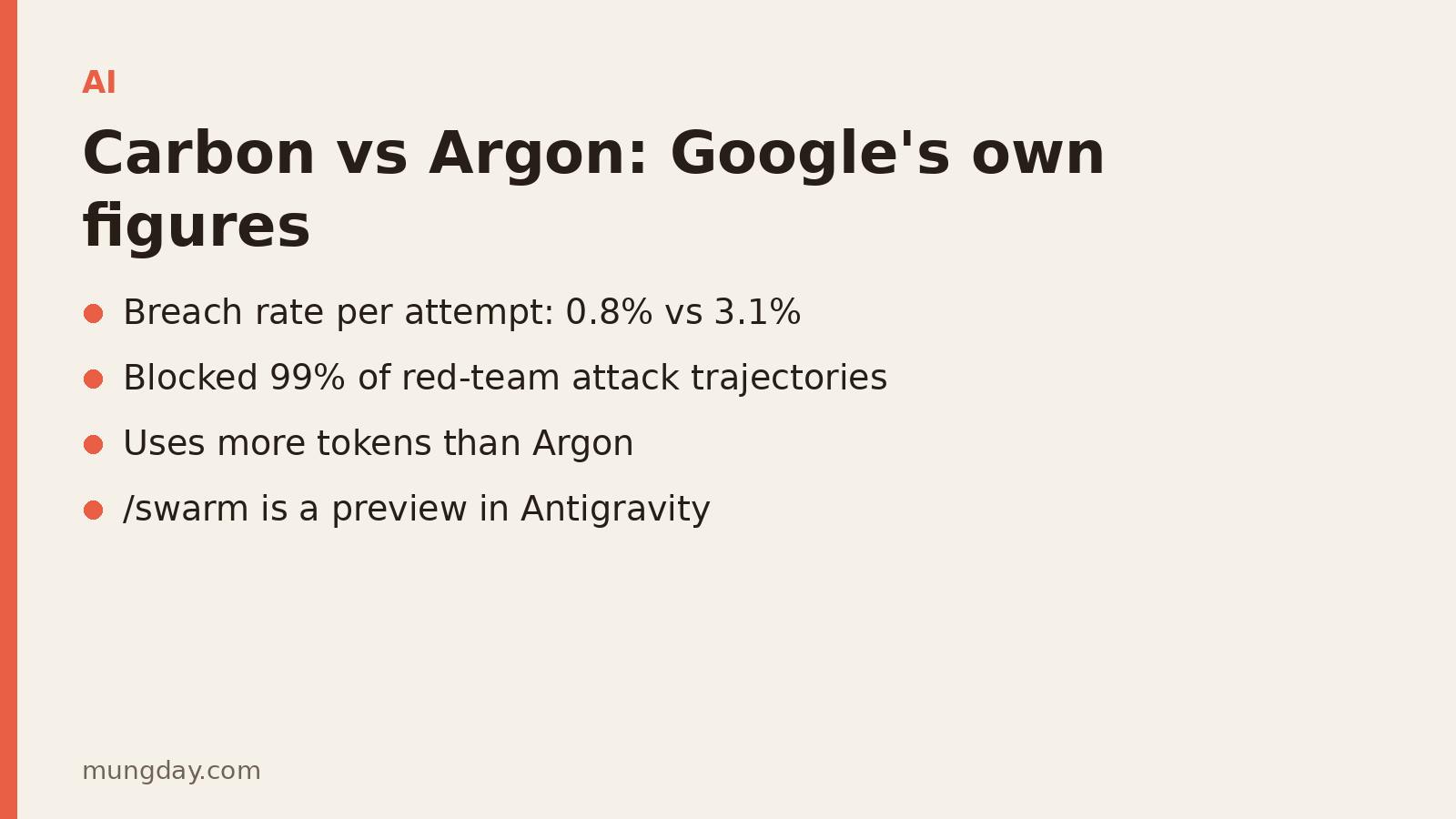
Google reports that Carbon blocked most attacks in simulated environments and that its safeguards cut the per-attempt breach rate from 3.1% on Argon to 0.8%. It also previewed /swarm in Antigravity, which turns one prompt into a team of coordinated agents. Treat these as vendor claims until independent testing appears.
Who should care
- API developers on the paid tier: run your own tasks before November 30 and price them at the higher rate.
- Ultra subscribers: expect a staged rollout rather than instant access.
- Security teams: the cyber-specific access runs through Fairwind and is gated.
- Everyone else: nothing changes yet.
What is still unknown
Google’s page does not publish specific rate limits or quotas. Independent price trackers have posted conflicting dates and details, so I relied only on Google’s post for numbers. For a comparison point from another lab, see our look at Claude Fable 5.2 pricing and speed.